Wheatfield Near Fort Pierre, South Dakota. Photograph by Robert Clements

Monday, November 17, 2014

Gonna Climb Me a Mountain


Rua and I near the top of Lookout Mountain. 
Lookout Mountain isn't intimidating. It doesn't loom over the City of Spearfish like a citadel. True, it's 4,452 feet high, but that's only 800 feet above the city. It's a knobby little knoll in the scheme of things, but it does play its part as eye candy every day. It sits back from I-90 and it dominates the skyline when I drive down the hill into town. It exposes sunrises, reflects the fires of sunsets, and defines the backdrop of the region toward the northeast. It's an easy climb, and it's been tempting me to do just that ever since I've lived in Spearfish.

I've lived here for almost four years, and it has become embarrassing to admit that I hadn't climbed it. It's been one of those thoughts that's crossed my mind every time I see it. "I have to climb Lookout Mountain," is generally the unspoken statement in my head, followed by, "I can't believe I haven't done it. It's there. It's probably not hard. The view would be gorgeous."

The meadows beside the paths are stunning during the autumn.
I've climbed many mountains. I've found myself on the peaks of many of the White Mountains, including Mt. Washington. I've hiked up several Maine mountains, including the tallest, Mt. Katahdin. I've even crossed the knee-knocking, awe-inspiring, rocky path called the  Knife's Edge between the Pamola and Baxter peaks on Katahdin. I did that during a year when I had hiked a lot, including down in the Grand Canyon and up again, when my balance and my confidence overcame my fear of heights. Could I do it now? No. My knees and my balance are less than stellar, these days.

But I could climb Lookout Mountain, and a couple of Sundays ago, I did. It was the last day of the year when snow wouldn't be an issue. Bob and I started out in the afternoon, with Rua. A front was moving in. We didn't know that the front was actually winter arriving early, complete with sub-zero temps. But that afternoon was perfect for the climb up Lookout Mountain.

Actually, Lookout Mountain has been conquered, a lot. In fact, it was being conquered that day by bikers, by a family with a baby in a backpack accompanied by dog, a couple of college students, and us. If one reads the description of the hike, one knows that it's a haven for mountain bikers, families, and people like me, who feel guilty just admiring it from a distance. It isn't tough to climb. You just have to do it.

The path (there are hundreds) we took up was steep, actually, and scored deep into the red earth by mountain bikers. We stopped, many times, to catch our singular breaths and collectively admire how far we had come. Spearfish spread itself below us. The cold wind shepherding the steely autumn clouds out for the season was sweet and sassy. We climbed further. Stopped to breathe. Climbed more. Wondered if it would rain and decided we didn't care.

A boulder at the top of Lookout Mountain. Remained unclimbed. Small dog with delusions of grandeur in tow. 
The lack of trees is one reason I like hiking in the West. In the East, thick groves of pine, spruce, and fir trees often crowd a trail for miles, leaving little room for views. But in the West, one can rise above a tree line in short order, and views abound. A service road for cattle and/or for the electrical lines that cross the hills leading to Lookout Mountain was an easy way to rise, for a short time.

The closer I get to the top of a mountain, the more I want to get there. I'm drawn to the peak, to the sky, to the wind, to the act of climbing a mountain. Even if the mountain is small, I find it hard to stop for anyone. That Sunday climb was no exception. Bob had led us for most of the way, but about five sixths of the way up, Bob decided to stay in a high mountain meadow and admire the spread of prairie and landmarks a few hundred feet below the top of Lookout Mountain. That was fine with me. I headed for the top, dog trotting after me.

The grasses along the path were varied and incredibly beautiful. Browns, reds, green, and gold, silvered, violet and orange, just magic. Rua and I wound our way through groves of small pines and up along a path with an close edge that made me slightly uncomfortable, but we kept going. We passed the family with the baby and the dog. We had a short conversation, passed by, and Rua and I were alone.

More grasses. Beautiful.
I scooted Rua up over a rocky, rooted path, and then climbed up after her. Several large boulders sat above us, but I didn't tackle them to make the exact top of the mountain. Having a small dog with a big spirit along made me aware that she might try to follow me, and I was conscious of her safety. We sat for a minute in our little spot, and looked down over Spearfish. I ate a granola bar and had some water, and she ate her supper.

The view from the top of Lookout Mountain.
We climbed down to meet Bob, and descended, which is always harder for me. I use a walking stick these days to coddle my left knee. The day was late, and I wanted the comfort of a warm house and a Sunday night supper.

When I see Lookout Mountain now, I no longer feel guilty for not having climbed it. I can picture the climb, the view, the top, and I feel as if we've come to an understanding. I know you, Lookout Mountain, I say to it, and you know me back.

Monday, September 29, 2014

The License Plate Game

My South Dakota License Plate. It's hard to read. Take note, all who pass me. 

I'm an old hand at traveling back and forth from South Dakota to Maine and back. A distance of 2100 miles to and 2100 miles fro and I've pretty much got it down.

Day One: Take off at about 7:00 a.m. Drive to Wall for gas and a donut. Drive forever, unless I and the dog have to pee, until I reach Sioux Falls. Turn right, and end up in Iowa. Stay overnight in said Iowa. Unpack dog and cat, pack back up in the morning. This last thing, all three days. They are remarkable and patient travel companions.

Day Two: Take off at about 7:00 a.m. The second day is the most stressful. I head right toward Chicago and race around the perimeter of it, on I-80. The last time I did it, I ended up taking a wrong exit, which is always a big fear of mine. What will happen? Who will save me? I ended up in a tight and uncomfortable traffic jam that spit us out into LaPorte, Indiana, where my GPS guy, Garmando, who tactfully didn't say, "I told you to take that exit, idiot," found I-80 East again. After going through Indiana, I reach Ohio, race through Cleveland on I-80, and head up to Erie, PA for the second night.  

Day Three: Take off at about 7:00 a.m. This is the longest day. I'm heading for the ocean, and I can't get there, soon enough. When did New York and Massachusetts, both of which I have to cross, get so big? Finally, I get to the BRIDGE. Everyone who loves Maine, who comes home over that BRIDGE, knows the one I mean. And everyone who has been away who crosses that BRIDGE from New Hampshire to Maine and home does what I do. They laugh and cry, and whoop and holler, and then they open the windows to suck in some Maine air. It really is different. It smells like home.  

And, I'm never home, long enough. When I leave, I perform the opposite actions. Erie the first night, Iowa the second, and back to Spearfish on the third. The third day, another BRIDGE takes me across the Missouri and puts me on a galloping path up a big hill and into the West, onto the high plains and prairie, and into the Black Hills, which are not for sale.   

Here are some observations.
  • South Dakota highways are awesome. 
  • Iowa (particularly the southern part) is one of the most beautiful states I've ever driven through.
  • Ohio has the best rest stops. The sign that says Ashtabula reminds me of two Bobs. Clements and Dylan. I try to call the first Bob when I see the sign, to tell him I'm in Ashtabula because we get a kick out of the fact that Bob Dylan uses the word in a lyric. …I'll look for you on old Honolulu, San Francisco, Ashtabula…(from You're Gonna Make Me Lonesome When You Go).  
  • I can't remember much about Indiana, save for the towns surrounding Notre Dame and the signs leading to Fort Wayne. If I took that detour, I could visit my ex-husband. I never do. I've already been that route.  
  • No matter what day or time I try to sneak through Chicago, even on I-80, I wind up tear-assing through six lanes of traffic, ready to snarl at the dog or cat should either one make a peep. I rejoice when it's over. It's ugly and nasty and I want my Mommy and/or a glass of wine.
  • I can't believe they put a 90-degree angled turn in Cleveland.  
  • Lake Erie is really big. Gordon Lightfoot wrote The Wreck of the Edmund Fitzgerald so that I could think of this every time I see the lake. …and farther below Lake Ontario takes in what Lake Erie can send her….
  • The Berkshires are beautiful and every time I go through Stockbridge, James Taylor croons to me from his song, Rockabye Sweet Baby James. Said lyrics: ...and so were the Berkshires from Stockbridge to Boston….
  • My license plate is among the rarest spotted during the license plate game. And I know when people might be playing that game.
How do I know? Someone starts to pass. I see them pull out. I wait forever and then I peer into my rearview mirror to see that they are hanging on my rear bumper. I know what they are doing. They are trying to figure out where I'm from. There are two clues. One is a funky photo of Mt. Rushmore. If a traveler knows where that is, then they'll figure out that I'm from South Dakota. If they don't know, the other clue is the fuzzy, smudgy letters way to the top of the plate that reads "South Dakota" in red cursive. It's hard to make out when one is driving eighty miles an hour. Heck, it's hard to make out when one walks right up to it. I almost hit a pedestrian in the Kennebunk, Maine rest stop when I started to back up before noticing that she was walking up to the rear of my car. She studied it and then toddled off, shouting to her friend back on the sidewalk, "It's South Dakota!"

Driving across the country is a long, long journey and the license plate game is one way to keep from going nuts. Of course, electronics keep a large part of the population entertained, but some must still get carsick, or like to contemplate their lives while staring blindly at scenery. I like to believe that spotting my license plate gives a carload something to keep them going, keep them hoping, until their own journey ends.  

I did the very same thing once, with a friend, as we drove from Maine to Arizona and back. We saw the license plates from all 50 states. The last one we found? The one that sent us past them in a road-weary hysterical frenzy? The one that obsessed us from Utah until the sighting on the Oklahoma panhandle? No, not South Dakota. It was an even rarer find.

It was our neighbor upstairs. North Dakota.  

Friday, February 21, 2014

ANY MESSAGES?

I once saw a New Yorker cartoon in an issue published either close to or in the midst of spring. A happy bird sat on the windowsill of an open window with its beak cracked open in a wide grin. "I'm back," read the caption. "Any messages?" That's all I have to say about that. I've been gone. I'm back. "Any messages?"

We are - the world - all waiting for spring. We are waiting for that bird, and yes, we have messages. The primary message is, of course, "Where the hell have you been?" In Maine, the weather is crushing the roofs and the spirits of even the toughest Yankees. The snow will not quit, but neither will my fellow Mainers. They will triumph, I'm sure, but they'll have sore backs and arms.

White horse, survivor of the winter storm, Atlas. 
Here in western South Dakota, it's been relatively mild, with the exception of one devastating cruel storm last October 4th that punched out the lights and the hearts of the most stoic of ranchers by killing thousands of cattle and other livestock. And horses. it was the death of the horses that surprised everyone. That, evidently, is a rarity. The government was shut down, which didn't help anyone, but the West takes care of its own, and it did, as best it could, with fundraisers and donated cattle and horses, and help from neighbors and neighboring fly-over states. They've told me that the East often has no idea of what tragedies or big events have occurred out here, and I saw that first hand after the storm. About 40,000 head of livestock died of hypothermia or suffocation, affecting the lives of generations of ranchers, and it took about a week for the fact of it to reach the New York Times. By that time, as it would be in Maine, a dazed but fierce recovery effort was underway.

A pair of Eurasian Collared Doves perched on the remainder of a large maple tree branch. 
The other casualties were trees, or parts of trees, or branches. Here in Spearfish, and I imagine in surrounding towns, tree cleanup is still going on. Where once there was shelter, now there are stumps. Almost every deciduous tree suffered some sort of ice-fueled amputation. It took Bob and I three days to clear the yard of branches and debris. Workers are now performing surgery throughout the town to help strengthen each tree. Rua and I are familiar to the worker who drives a tiny bulldozer along the walking paths of the parks. I wonder if he sees tree parts and sawdust when he closes his eyes at night.

Tula Mae
Rua, my Cairn Terrier, is about eleven and a half now. We've been struggling with a localized tumor in her left leg for about two and a half years now, performing lumpectomies when it got cumbersome. I'm happy to report that she is in remission and that she's waiting for a walk. We also have a new kitten, Tula Mae. She was about six weeks old and a foster for about five minutes in our house, until her little starved body found a cubby hole in our kitchen near the heater, and found nooks in our hearts. I didn't want a kitten, wasn't looking for a kitten, much less a female kitten, but here is she, and she's fabulous. She just came into the office wanting my help in untangling the yarn she'd wrapped around her legs and neck. Rua and she are friends, which Jessie would like, I think.

I've written another novel during my time away from the blog. A sequel to Red Ruby Heart in a Cold Blue Sea. It will be published in German, first, as was Red Ruby Heart. The title, in English, will be Cold Blue Sea, Endless Sky. Writing this book was an entirely different experience. The first novel is written at one's leisure, because it's just for practice. The second novel is written on deadline. This sequel drew blood, sweat, and tears, I'll tell you that! The tone is completely different, almost frantic and filled with a lack of time. Writing a book about characters suffering from a lack of time can be tense, but in the end, I loved what came out of it. I love my characters, Florine, Bud, Dottie, Glen, and all the residents of The Point.

Eagles fill my eyes these days. I spot them along the creek, searching out fishing spots. Turkeys also loom large, in big, big flocks. The deer are suspiciously scarce, this winter. I still have not seen an elk out here, although Bob and I have been to places where they are allegedly common. It's like Puffins on the East Coast. I've never seen one, but they tell me they exist. At this point, if I spotted an elk or a puffin, it might take away from all that I have imagined them to be.

"Any messages?" One. Come, Spring.

Sunday, April 21, 2013

Somewhere Near Tomato Can Buttes

Yesterday, on one of our road-trips up north, we had a traffic event. Robert, who knows how to keep a cool head during interesting vehicle shenanigans, managed to keep us on course. He has written a beautiful piece on it that I would like to share with you all. 

Robert Clements, Artist and Photographer.

Somewhere down the road from the Tomato Can Buttes we hit a bump. A cattle guard, a metal grate in the road to keep livestock on the right side of the fence and to allow vehicle passage without having to open and close gates, had settled about 18 inches lower than the surface of the road.  Muddy road, speed (40 mph maybe) and driver distraction equals Big bump. I didn't yell "Hold my beer & watch this". I did yell. Something like 'hold on' and maybe a 4 letter word that means oh-oh. 

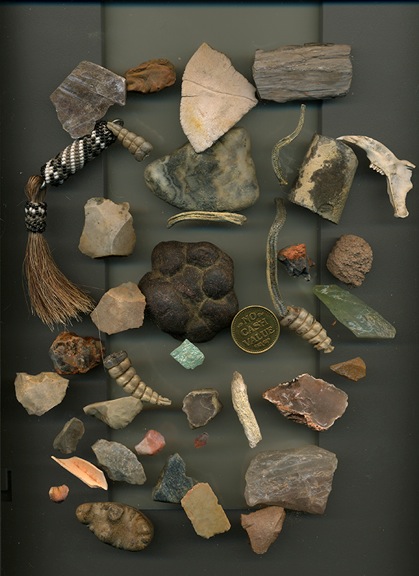
No damage to humans, animals or vehicle. That was a surprise. What did happen was all the stuff on the dashboard in little pockets & trays designed for keys & sunglasses flew into the air and dispursed itself into other places around the pickup. This 'stuff' was several years worth of specimens, souvenirs and samples of nature & events. I'd like to think of myself as more of a naturalist rather than psycho-billy artist who has never met a rock, bone or feather that I didn't like. It's probably a distinction that matters little. 

Tomato Can Buttes and Two Cottonwoods.

Among the stuff that went into the air with enough dust to nearly set off an asthma attack were some rattlesnake rattles, more than I thought I had. Baculite segments. Green Calcite (I haven't found the yellow calcite yet) petrified wood, rose quartz, prairie agates. A bead & horsehair Navajo tchotchke,  lots of chips, flakes and broken arrowheads. Rose petals crumbled unto dust, from my mother's funeral.  The jaw bone from a jackrabbit or prairie dog. Four inches of a 6-inch garter snake that had the misfortune to be outside when winter hit. Perfect freeze-dried preservation, though the colors had faded from its time on the dash.  We'll see where the missing parts turn up. Mica. Part of a turtle shell. Crystal, bones and rocks I don't know the name of. An iron concretion that looks like a puppy dog footprint. 


Dashboard treasures from the Plains and Prairie. 

I can't always remember where my glasses or keys are, or why I walked into this room, but because I mostly remember the very moment and place, including the temperature, light and smell where I picked up each of these items, I'm much less fearful of the future. 

Maybe even comforted.

Saturday, March 16, 2013

I Miss My Girls

No photos on this one because there are too many to post and because this post has to do with the heart, rather than the eyes. It has to do with people who knew me before electronics, before cyberspace, before the use of personal computers, when all we had were land phones and we listened for our favorite songs through the crackle of AM radio stations.

It's Saturday, and I'm missing my women friends back East, is all. I have made a few friends here, and they are dear to me, but oh, how I miss women who really know me, have known me for a long time, and like me, anyway. And oh, how I love them. "And later, nighttime songs came back again," sang Carlie Simon. "But the singers don't compare to those I knew...".

If you looked carefully, back then, you would see a motley group of young girls with thin, filly-worthy bare legs and grubby skinned knees, galloping in a herd through the neighborhood cemetery. I miss those women who praised imagination as life in its highest form and had complete faith that, whatever we wanted to become, so it would be. I miss our faith, our awkwardness, and our complete and utter allegiance to one another.

I'm thinking of those women who have made me laugh so hard that a trip to the bathroom came too late, and we didn't care. We laughed harder, is all. As teenagers, we sat around kitchen tables steeped in the wonder of our astrological signs - I wanted to be a Scorpio back then - and consulted Ouija boards for conversations with ghosts who inhabited our houses and our minds. We went to movies that held us spellbound long after we left the theater. We had overnights in which I would wake up, hear my friends breathing, and know that all was right with the world. We went to the local coffee house and pretended to ignore the boys that we longed for with all of our hearts.

I'm homesick for the women I've cried with over deceased pets, the unfairness of parental dictates on our behavior or lack thereof, bad breakups, the deaths of President Kennedy, John Lennon, Martin Luther King, Robert Kennedy, Janis Joplin, Jimi Hendrix and so many others, the absolute tragedy of a dead bird, the fear and loathing of not being cool, and the loyal and indignant comfort offered after humiliating situations that we thought we would never get over.

On weekends back East, I lived alone. Every weekend I visited at least one friend for coffee and conversation, for walks and talks and validation, for comparisons on our relationships or lack thereof, for dog time, cat time, theater time, time, time. Somehow, during those short hours, we solved, resolved, or redirected the pathos and paths that made up the emotional trajectories of our lives. We got through everything intact for the most part, and with the understanding that someone out there believed in us like no one else ever would or could.  

When I was writing my novel in my little house, I would come out after several long sessions with pretend people, dazed and wondering where everyone went. It always feels strange to enter the world again, after leaving it to perform what is essentially magic with your mind. But I could always call a girlfriend for lunch, or a chat, or just to make a connection that would tell me that life was running on most of its cylinders, that their children and/or spouses were fine, and that the real world was functioning without me in it for a while. They were the ones who were most excited when the novel was finished and released. I miss those celebrations and I miss celebrating their triumphs.

We all need that. At any age.

Robert and I talk about how it's harder to make friends at our age. Everyone is busy and they have their own lives. And we live in a new place that is remote and people are far flung. For lunch, for instance, the women I know travel 50 miles or more to enjoy one another's company. We don't meet often, and it's special when we do. Lunch lasts for hours. As it should.

Here, I'm meeting my friends as an adult. At this point, we've solved most of our more melodramatic situations and we've learned how to manage. We encourage one another, and help out when we can. We have developed mountains of coping skills and strength and we have our own families to shelter our dreams and our sorrows. Hours once spent spilling secrets and drinking tea or wine have dwindled to the amount of time it takes to be interrupted by a cell phone call. We are more guarded, because we should know better by now, I guess. I don't know. I still feel 14 sometimes, with its aches and confusions. And that's when I miss my women the most. It was my choice to live here in this strangely beautiful place, and I love my partner.

All that has nothing to do with how I miss my women.

On this day before St. Patrick's Day, I raise an crystal-etched filled glass with good red wine to cherished memories and rock-solid friendships that go back before the beginning of who I am now, here, writing on a laptop in a small college town in this big state where, when I shout out my heart's desire, I hear an echo most of the time.

I would rather hear the voice of my oldest friend who hates the phone, the voice of my friend who still has honey-blond hair and a love for animals and fantasy, the wise counsel of my friend with the deep voice and the wicked laugh, the soft voice of my friend who listens like no one else, the humor and toughness of my friend with the greyhounds, my beloved pearls, my New England sister, my friend who lives somewhere near Seattle, my six-grade girlfriend who had a dog named Skipper, my ever-missed Lovie, Hadley Raymond, and so many more. We can reach out and touch each other whenever we want. We can call, email, Facebook, text, twitter, hash tag, and/or do some Face Time or Skype.

I just wish, with all of my heart, that I could hug one of them, right now.

Monday, January 14, 2013

Bird Feeder

This is how he works.

I make an impulse buy of bird food at Safeway, figuring I'll begin to feed the birds. I bring it home and put it down by the boots and coats in the mudroom of our house. He comes home that night and sees the birdseed.

"Do you want me to build you a bird feeder?" he says.

I hesitate. I'm used to doing things by myself and I can buy a bird feeder at a hardware store. Or get a hammer and nails and pound one together. That probably would never happen, but I'm an independent, two-fisted, I-Can-Do-It-Myself Maine woman and I could do it if I wanted to do it. After pausing, I say, "Sure," and forget about it.

I visit the gallery one day. "Want to see your bird feeder?" he says. Okay, why not. I follow him to his work area, where I look for some small rough-wooded contraption that he's glued together, but that isn't what he's doing.

What he's done is to take a piece of PVC pipe and attach it to the underside of the plastic top of a plastic bucket. He then has drilled holes into the bottom of the PVC pipe so that we can fill the hollow pipe with bird seed and it will dribble out of the holes into the bucket top feeder. He has a plastic cap that fits over the hollow PVC, bird seed-filled pipe. This cap will protect the bird seed from possible marauders.

The bird feeder.

To keep out the squirrels and the weather, he has fashioned a cap from part of an old tin ceiling to protect the bird food. Then, he affixes steel rods with little hooks on the end for perches, along with wooden chicken-terayaki sticks that circle the feeder so that the birds can perch while waiting to eat.

Old tin roof from a ceiling for the cover. Metal and wooden perches for the feeding birds.

We ponder how to hang the bird feeder, which has a triangular handle. He was originally going to hang the feeder on a chain link, up high so that the deer won't shoulder their voracious way into the seeds and scatter them all to kingdom come. I nix the chain link idea because it sounds heavy and cold and cumbersome to handle, because, after all, this is my idea and I will be the one to take care of the seed.

So, he fashions a pulley-operated, slim, but strong green rope with which I can raise and lower the feeder.  He screws a cleat into the tree we've selected to hang the feeder on, so that I can wrap the rope around it to keep the feeder aloft.

How I raise and lower the bird feeder.

We fill the feeder and pull it up for its maiden voyage. Then I sit in the living room and wait. In an hour, I'm impatient and bereft because the birds aren't using it. Any birds. "They're used to their own places," he says. "They'll discover it." And they do. The first bird I see flit onto the feeder, grab something within a millisecond, and dash away with it is a black-capped chickadee. The chickadee-dee-dee is Maine's state bird. I take this as a sign that my South Dakota feeder has Maine roots.

Now, a feisty group of dark-eyed juncos is enjoying the benefits of the fruits of his labor. One piggy blue jay landed briefly, but the tin-ceiling is too low, and it didn't stay long. It gives me great pleasure to watch the birds enjoy the food on these cold, snowy days. The dog and I go out every morning to fill the feeder and to scatter more near the bushes where the juncos hang out.

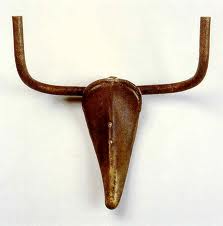
And I'm astounded at his creativity. The way he thinks amazes me. The bird feeder, and the practical use of seemingly disparate materials he used to put it together, reminds me of what Picasso did with a bicycle seat and bicycle handle bars.

Pablo Picasso, Bull's Head and Horns, fashioned from a bicycle seat and handle bars.

It also reminds me to let him in. To answer "Yes" when he suggests that he build something, or do something, or cook something for me, instead of pausing to wonder if he thinks that I'm too stupid to do it myself. Or, in its darkest form, wondering if his offer is a trick that will somehow come back to bite me in the butt.

How about this? I can accept his offers, and attach them to something completely foreign to me, like cooperative partnership, turn my heart upside down so that it holds what he has to offer, cover it with trust, and lower it so that I can fill it with patience and love, along with millet, peanuts, and sunflower seeds. Then, I can raise it up again and wait to see what lands there to feed so that it can digest the sustenance and strength it needs to take flight.    

Tuesday, December 11, 2012

A Girl and a Yearling

Cozy doe, resting after the first snowfall in Spearfish, back in November.
A doe and two fawns are lying in my backyard this morning, long legs folded neatly, eyes half shut, chewing cud. It thrills me to see them, but I worry about what will happen to them when they leave. Stay off the roads, I want to say to them. But they probably won't, or can't as they need to get from here to there, like the rest of us.

I don't believe they ever really sleep. They are ready for flight at the slam of a car door, or a dog barking in the neighborhood, or a scent wafting toward them. One of the fawns is an orphan or has been separated from its mother. The doe occasionally flattens her ears and chases it around in a half-hearted manner. They perform this dance for a few minutes. The orphan finally settles down again, and so does the doe. I walk around the inside of my house whispering, lest they hear me and take off again. I think they're perfect, with their big eyes and long legs. If I grew flowers, or a garden, yeah, I'd probably be annoyed, but that's why God made eight-foot fences.

Another backyard beauty.
If I don't see a deer - there are two kinds - Whitetail and Mule - during the day, here in South Dakota, I consider it odd. In Spearfish, which lies wrapped in the arms of the Northern Black Hills, under the watchful eye of Crow Peak, deer are part of the neighborhood. They trek through the yards and parks and eat grass or bushes and I know that they are considered pests - some towns have initiated culls - but I still consider it a little bit magical to see them. I'm from Maine, where the woods are thick and there are countless places to hide. 

When I was a kid, to see a deer was a rare thing to be celebrated. I looked for them alongside the roads and listened for their footsteps in the woods. People and houses weren't so plentiful, so they had more habitat. We lived on a dirt road in the summer back then, and I was always on the watch for them. One day, a bunch of us kids, traipsing back from blueberry fields long since taken over by rip-rap and new owners, startled a young fawn, which bolted from its hiding place and bleated its snowy-spotted way on wobbly, ridiculously long legs, down the road. It scared us as much as we scared it, We pell-melled toward home, terrified that its daddy, who I know now could have cared less, would gore us, or that its momma would slice us with her pointed hooves. 

Once we saw a herd of deer in a field across the road while we were in the car with my father. It was a stop and stare moment, until each deer, one by one, melted back into the woods. The buck stood last, then turned and walked away into the trees. I remember the awed tone in my father's voice, and he was a man who, back then, didn't appeared to be awed by much, especially by his four grubby children. Another time, I was driving in a car with my Uncle Dick, on our way to the rural community of Woolwich, where I was to babysit my four hellion cousins. I saw a deer standing on the top of a hill at the edge of the woods, looking down on the road. "I saw a deer!" I hollered. "Oh, Uncle Dickie, I saw a deer!" To me, it was akin to seeing a unicorn. Uncle Dick loved animals, and I loved going to 'The Farm', where the possibility of seeing a deer or a raccoon or skunk or another exotic species, or of rescuing kittens and roaming the woods with a dog, was just around the corner.

I read Bambi by Felix Salten when I was probably too young to read it. No Disney version for me - this was the real thing. Yes, the deer had voices, but Salten caught their joy and despair perfectly, as well as their dignity and their beauty. I wanted to be Bambi after I read it. Well, I wanted to be a horse, too. In fact, I wanted to be a four-footed animal when I was a girl. It just seemed much more comfortable to not have to speak and to have the means to take flight. Or maybe I just thought they, horses and deer, were the epitome of grace and loveliness. I still do. 

This buck visited my backyard during hunting season. Smart move.
When I lived in England in my early twenties, I walked almost daily in Thetford Forest in Norfolk. There, I saw a herd of tiny Roe deer. Elf deer, it seemed to me. Another magic moment. These are the minutes on the planet where I feel I get glimpses into another world, where it's a privilege to bear witness to the mystery of a free and wild creature. Sightings like these are an inhale of grace and an exhale of joy.

I understand the danger that deer can be on a road - very real danger at night - and I realize that they can be destructive. And the possibility of the spread of disease from ticks and other pests increases, as deer, like the rest of us, are forced to share limited space and resources. Yet, I still look with a child's eye when I see them. Marjorie Kinnan Rawlings penned one of the most powerful endings ever to her incredible book, The Yearling, regarding the relationship between a boy and his fawn, between childhood and adulthood and innocence and experience. It always makes me cry. Somewhere beyond the sink hole, past the magnolia, under the live oaks, a boy and a yearling ran side by side, and were gone forever, wrote Kinnan Rawlings. Maybe that's what seeing a deer does for me - brings back the reverence I felt during a time that has become less reverent and more ragged, the older I get. 

So, I'm glad the deer are resting in the backyard. They're giving me a good dose of awe for the day. 

Friday, November 16, 2012

Distractions


If I were my boss, I'd fire me.

Biggest distraction of all. Myself. (Photo by Heather Perry Weafer - who was doing her job.)
I used to work for other people. I worked for other people for over 40 years. I showed up on time and did what was expected, with the exception of one job I had in the early nineties that expected WAY too much from everyone. I took vacations and holidays, had an office mug and some knick-knacks that either inspired me or reminded me of why I needed to work, had office buddies, some of whom are still great friends, and had great health insurance. I commuted in various little cars through rain, sleet, or snow, biked, or walked to work. I did my job, and I got paid, commensurate with experience.

Another distraction. A cute one, but a distraction.
These days, I work for myself. I get up at six a.m., make coffee for my honey, kiss my honey goodbye, take the dog out, eat breakfast, walk the dog, make tea, put the dog outside, check the computer three times in a row - Gmail, Yahoo mail, Facebook, go to the bathroom, switch on the television, switch it off, check on the dog, check on the computer again, because it's been ten minutes and something important may have come in, adjust the temperature, freshen up the tea, and walk into the office, about a half hour late. I bite my nails, then look at them. Good thing I have an emery board at the ready. Oh, wait, it's kind of worn. Time to get up and get a fresh one. I know it's somewhere, and when I find it, I'll sit back down, file my raggedy nails, and get to it.

Facebook, gmail, yahoo mail, and so on. Big distractions. 
I'm my own worst nightmare. I should document my truancy, verbally at first. Bad Morgan, bad, bad. You've been warned. You are now on a program. Then written - but of course, that would require writing, which is my job that I'm not doing because of DISTRACTIONS. It's not my fault. DISTRACTIONS. Yeah. Right. Consider this a written warning. If you're late, one more time - here's your hat, what's your hurry?


Food distractions abound.
Writers are notorious procrastinators. It's been documented by so many writers. Writing about why we don't write is another form of procrastination. We all know why we don't write. It's due to - drum roll - procrastination. My favorite piece on creative procrastination was written by Carolyn Chute for the New York Times. How Can You Create Fiction When Reality Comes to Call? Great title. Wish I'd thought of that. Wish I'd written the piece. Wish I'd written the piece and had it published in The New York Times. Wish I'd gotten paid for that. But that would require discipline, and well, I've found the emery boards. Time to check on the dog. She used to have a yard where she roamed free, but now I have to tie her because we don't have a fence, so.  The dog is fine. She's sleeping in the yard. She's doing her job. I should get to mine.

Must. Have. Tea.
Should I turn up the heat? Should I go to the bathroom now so I won't have to stop what I'm doing, later? Should I make sure the dog is still happy? Should I call my honey before he calls me to ask if he's interrupting me?

Go now? Or later?

Why is it that we put off doing the very thing that we love the most? I do the same thing when I'm writing, actually. I call it scene avoidance. When I most want to delve into THE BIG MOMENT, I write around it. What I have discovered is that everything leading up to THE BIG MOMENT, everything surrounding THE BIG MOMENT, is what's important. It's called setting the scene. THE BIG MOMENT is the climax, and then, well, on to the next BIG MOMENT.  So, maybe, I am establishing the groundwork for the psychic BIG MOMENT - the use of my imagination, which is the best part of me. It's so good I can't take it, I guess. I should get to it.

I'm cold. I'm going to turn up the heat. Then, I'll start the day.

Wednesday, September 26, 2012

A Portrait: Flannel Coat, Covered with Cat Hair, on a Chair in the Study

Jessie Callan Rogers sleeping in the truck.

I am putting off going into my study. The day before yesterday, I walked into that room, picked up my cat, Jessie, from where he was curled like a comma on my flannel checked coat on my office chair, put him into his cat carrier and took him to the veterinarian's office, where I had him euthanized. The imprint of his little body still owns the seat of the chair and his fur is all over my coat. I don't want to change things, just yet, although I really have to move forward.

Jessie was thirteen years old. He was a fluffy gray cat with big paws, a tiny purr, beautiful green eyes, and a lovely temperament. He had a sense of humor and a gentle, adventurous side that I was constantly discovering, even as I worried about his physical reactions.

He was always fragile. He had crystals from the day I adopted him off the street. Crystals, for the uninitiated, are formed from body crud (like kidney stones) and can block a cat's urinary tract. If not treated, only catheterization may save the cat. It did in our case, but Jessie had to have special food, which he didn't like. I wrung my hands over that. He was also supposed to stay inside. I wrung my hands over that, too. Then I realized that stress is a big cause of crystals and UTIs in cats, so I decided to keep doing what we'd done before.  I let him out when he wanted to go, and fed him high-end, low ash food. "Shorter life, happier life," I said to the vet.

 When we moved from Maine to South Dakota, it was a huge change for me, let alone my tender flower of a feline. I fretted more about how the cat would react to being driven 2,100 miles than anything else. I even thought about giving him to someone else in Maine to save him the journey, until a friend suggested that he would do best with me, wherever I went. I obtained a few kitty-Prozac pills, gave him a half a pill to start the journey, and crossed my fingers.

Jessie Callan Rogers sitting in my suitcase. He loved to travel.
He was fine. Within twenty minutes of our departure, he was out of the carrier and exploring. He slept on my lap for most of the trip, and did fine when we stopped. I loved traveling with him, and we went back and forth and back one more time. He lived with two other cats in a huge gallery building and held his own while he was with them.

I did notice last autumn that he was very thin. I took him to our South Dakota vet, and he was diagnosed with kidney failure last December. Kidney failure is terminal, but terminal to me, at that time, meant I would take him back to Maine for the four winter months I would be there marketing my first novel. I would treat him there and, hopefully, he would survive for a long time. Our little core team of the dog, Jessie, and me, rented an Portland upstairs apartment from a heart-sister and her wonderful husband, and I went from book event to book event, even as I juggled any kind of cat food that Jessie would eat, plus chicken, turkey burger, hamburger - anything that kept his upset stomach busy - with plenty of available water and lots of rest.

Despite my efforts, he crashed in February, too dehydrated to defecate. I rushed him in to the Maine vet's offices, where he was hydrated. After that, I took him to the vet's offices to be hydrated on a weekly basis (I tried it at home. No freakin' way, he said, in one of the few disagreements we ever had about how we would live his life and help him to thrive) and I boarded him there if I was going to be gone overnight.

We came back to South Dakota in May and the hydration continued, along with new medication for his chronically upset stomach and another medication to keep his blood pressure down. He hated it when I squirted stuff into his mouth. I left twice during the summer, and Bob continued the treatment for me, boarding him if he wasn't able to be around for a couple of days.

About a month ago, I finally took over the hydration treatments, hooking up the lactated ringer bag and playing 'vet tech', by making it as clinical as I could. I placed a towel on the kitchen table, set him on it, and stuck a needle under his skin, running fluids subcutaneously so that they would be absorbed by his body. This worked for the first bag of ringers. I bought another bag of ringers only five days ago, along with new medicines and all kinds of cat foods. I am leaving for October, and I wanted to make sure we were prepared. Then Bob, being honest, said he wasn't sure he was comfortable giving him the fluids, so I made arrangements with the vet's office to have Bob drop Jessie off for fluids, and then pick him up and take him home. I left a credit for his care for the month.

But the truth is, during the last month, he failed in small, important ways. I kept food for him, always, and he forgot where it was kept. He would jump onto my lap for a cuddle and just stand there. He crouched in that way that cats have when they don't feel well. He slept for long periods of time. He vomited when his stomach was empty, but he wouldn't eat. He craved his morning walk-about outside so that he could eat grass. He appeared to have stiff back legs. His breath smelled of decay. He began to have accidents. Still, I wanted to keep him going for a year, till December, the date when he was diagnosed as terminal. I wanted to meet that anniversary. I was prepared to do that.

Jessie Callan Rogers, a day before he left for the Heaviside Layer.
But last Friday, when I was giving him the fluids, I pierced his thin, tired skin with the needle and more fluid dribbled out onto the towel than into his poor little body. His ribs and hip bones were prominent when I rubbed my hands over him. We'd been here, before, he and I, and we had come back. Sunday, I would give him more fluids, and things would improve.

But Sunday, I woke up and I didn't give him the fluids. And I knew that it wasn't about me meeting an anniversary to prove something to myself. It was time. Jessie had been telling me this for a month and I hadn't wanted to listen. I told Bob, and we both cried. But we didn't take it back.  I called the vet Monday morning and talked to my favorite vet tech, and we set a time. 3:15 p.m. Bob asked if he should be there, with me. No, I said. Jessie and I started together, and Jessie and I would end together.      

Jessie had a great day on his last day of life. He ate raw hamburger and chicken (some of this out of the dog's dish, unbeknown to the dog).  He saw birds in the yard and stalked them through the sliding glass door screen. I took him out into the yard and the birds flew off as he left his mark in an old garden plot. He ate grass and rolled over until his gray coat was flecked with dust and gold. I cuddled him on my lap for two hours, and when he was full and content, he went into the study and slept on my coat on the chair. I woke him up at 3:00 p.m., then drove to the vet's office, one hand on the steering wheel, one hand scratching his ear through the wire of the cat carrier. He sat quiet. He was a good passenger.

Inside the veterinarian's office, a woman with a Boston Terrier puppy waited at the counter, and I envied her and her dog their beginning. I set Jessie down and spoke to him quietly. The vet tech came in and sat down beside me with a paper that I had to sign, saying that this was my decision. I signed it. We talked for a bit about his situation. Then, it was time.

She left me with Jessie in an examination room and I dumped him out of his carrier and held him to me, thanking him for his gentle grace and his dignity, telling him that I had such a deep, quiet love for him and that I was sorry for doing what I was about to do. His vet and the tech came in then, and the vet said that he was sorry and that nobody liked to do this. He shaved Jessie's right front leg so that he could find a vein to insert the needle that would allow the deadly pink fluid to run through his veins and stop his heart. "Are you ready, Morgan?" the vet tech asked me. "It will be fast." I said, "Yes". The vet inserted the needle and blew Jessie's vein. We all took a breath and he apologized. He had to shave the other leg. Jessie never flinched. "I love you," I said to him and the vet inserted the needle, again.

It was fast. I felt Jessie relax against my hand and arm, and as he did this, I felt all the tension, all the pain, and all the things I had been making him hold on to so that he would survive so that I could love him another day, leave, and I thought, this was the right thing to do. He's gone, and he doesn't hurt anymore, and I'm glad that he had a good day. He had a wonderful life and I had a wonderful life with him. I have had animals before that I loved and kept alive, too long. With Jessie, it didn't get to the point where it was a desperate, painful situation. But oh god, it was hard. I will grieve for a long time for this sweet creature, who chose me to share his life.

I threw away the ringers and the medicine with a vengeance. I will give his bowls to the humane society. His scratching rope and his litter box I will remove, later. And I have to go into the study, because we have guests coming next week, and it doubles as a guest room. It's time to move on. And so, I'll end this piece, and I'll go into the study. It has to be done. So I'll do it.    

My beautiful cat, on his way to his next adventure.


Thursday, August 30, 2012

Family ReOnion

Red hot dogs and hamburgers. Trademarks of a Maine family reunion.
I straggled back to a family reunion in August, while I was back in Maine. We have only ever had family reunions on my mother's side. My father's family was tiny, compared to my mother's family. It consisted of his mother and my grandmother (Dottie), his sister and my aunt, Ginny, Uncle Martin (uncle-in-law), and Stevie, my cousin, who was a older than we were and subject to the exasperations felt by a cool teenager forced to hang out with giggly, goofy cousins.  After Stevie made his obligatory visit with us, he hightailed it out of the house for better climes. The visit drooped after that. We siblings saw each other every damn day. Our cousins were the lifeblood of the family get-togethers.

First and second cousins. One in-law.
On my mother's side of the family, we had tons of cousins to pick from. My mother had four siblings. There were four kids in our family and we had, eventually, nineteen cousins. My aunt had nine children, with four of those kids our ages. One uncle had four wild boys a little younger than me, but they were still part of the gang. We all made up the older cousins. Each of us had a companion - a special - cousin. The much younger cousins were ignored back then.

Boston husband of first cousin and Patriot's logo.  Of course.
Oh, the wildness of cousins! The anticipation of getting together to catch up and play! First, our parents, and the aunts and uncles forced us outside. We were actually locked out unless we needed something drastic and it had better be good. Left to our own devices, we fought with each other, confided secrets, laughed, cried, scraped ourselves up, fell out of trees, off bicycles, down gullies, and off docks. We sunned ourselves, shunned each other, pitted boys against the girls, yelled and screamed, and lived out tragicomic days and nights wracked by sunburns and the knowledge that our visits would end too soon.


Leading up stairs to the sleeping room.
We especially loved going to my nine-cousin camp on a fresh-water pond scraped out by a glacial march across the state. Summers, we grew up on a tidal, salt-water river. Swimming depended upon the tide table. Mudflats were awful to negotiate, and the temperature of the water depended on the number of sunny days. But the pond was a marvel of consistent height and temperature, a wonderland of sunfish and turtles, and a battleground of inner tube fights and swimming contests. One cousin who grew up on the pond complained once to my aunt that, "All they want to do is go swimming," and she was right. We stayed in the water until our fingers were pruned and our lips were blue. Then, forced out by the adults, we played horse shoes and board games, badminton and volleyball. We took walks, accompanied by mosquitoes and the dust and exhaust fumes from passing cars. At night, we all slept in one open upstairs room, two or three to a bed. The next day, we did it all again.

This past August, I drove my rented car up to the pond camp, toting my 85-year old parents with me. They had had a spat before our ride, generated mainly by the frustrations of a forced 24-hour existence together. They sat silent in the car, except for terse words spoken by my macular-degenerated dad who gave directions that were not to be questioned. My mother sat in the back seat, her tiny form taking in the scenery. We stopped and started through the mall-ladened insanity that has become North Windham and took the right turn onto the dusty road that leads to the cottage. I took a wrong turn and had to backtrack past a new white-picket fence that divides the roads and confuses the memories. I got back on track, followed the pond to my left, turned right, then left, and found the camp.

Apple clock hanging on chimney.
The camp is small, with a front screened-in porch and three inside downstairs rooms. Cottage kitsch and genuine antiques furnish the rooms. One bathroom has served us all for generations. The screen door sounds off with its camp slam and pine needles need to be brushed off before we can enter. No one is locked out, these days. Anyone can come into the camp, anytime, for anything.

Screen, cousins, aunts, and formidable man.
When we were kids, a cribbage board or a board game covered the oil-clothed table top on the porch at all times, with raucous competition between players. This August, two young second cousins and an original cousin played a game that I didn't recognize. My second cousins welcomed me into the play, but it wasn't the same. I longed for Monopoly, or Trivial Pursuit. I longed for my special cousin, unable to attend because of distance. I looked around at my uncle, aunt, and my parents, who hold up what is left of a generation debilitated by the loss of an aunt and three uncles. Layers are peeled off in families as time dictates. They looked incredibly fragile, even as they took up their end of the porch.
Strong woman in chair.

A bathhouse down a wood-planked walkway is stuffed with Styrofoam noodles, which didn't exist when we were kids, and inner tubes - not our inner tubes, but the inner tubes belonging to the new generation of cousins, a much smaller,  more scattered group. Once, a dragon fly the size of a crow landed on the inside of the bathhouse door and kept my sister and her special cousin prisoner for about an hour, terrified that it would sew their mouths shut.  A passing boy cousin finally shooed it away.

Second cousins and an in-law
with Styrofoam noodle.
A steep hill leads down to the pond and a dilapidated dock. A diving platform has been anchored a little way off the dock; something we never had when we cousins ruled the pond. Stone steps lead into the water now. Before, we either slipped or jumped onto the sandy bottom that leads out to a composted murk of weeds and water plants. My nephew, who will be a father next spring, tried to coax his dodgy Boxer dog into the water. I watched teen-aged second cousins and a brother-in-law floating on a purple noodle play in the water while I sat on a bench with my sister and her cousin, just as our mothers had done before us.  "Come on in," my nephew urged me, and I went up for my suit.

The dock, second-cousin, nephew and boxer, in-law.
I stood in the stultified air of the upstairs common bedroom and heard the breathing of my generation as it slept away a summer night, oblivious to the fact that some day, a middle-aged woman struggling into her unflattering but comfortable bathing suit would wonder at the expiration date of youth.  I walked down the steep hill to the water, holding on to the rope that was once scorned as the crutch of the timid and lame, and stepped down the slimy rocks into the pond water.

A twenty-something niece, who only has four cousins, joined me and we swam out to the diving platform, where I struggled for a few undignified seconds to get up a ladder, then I gave up and swam past it, toward the other side of the pond. My niece and I parted the waters in front of us and noted the quiet. I remembered that the pond was filled with the roar of over-sized motor boats once, and kids screamed as they jumped off docks, and the smells of grills cluttered with red hot dogs and hamburger meat scorched the summer air. This August day was cool, with the chance of rain. No motorboat cracked the peace or threatened to run us over. The grill was located behind the came and away from the water, which took on a faint aroma of swamp, of dank age, of something not sunfish lurking in the muck far below us. I turned around frequently and looked back at the distance we had swum, at the little figures in the water and at those walking up and down the steep hill, wrapped in towels and anticipating lunch.

Diving dock in pond.
My niece and I talked a little bit during our swim, but not much. She's quiet, this one. My special cousin could out-swim me when we were kids, and she did, leaving me behind to always finish last in our quest to touch the bushes on the other side of the pond. But on this August day my niece swam beside me, and she waited while I waded through leach-infested muck to touch the bushes, like I used to do. Then she swam back across the pond with me toward grandmothers and grandfathers, fathers and mothers, aunts and uncles, sisters and brothers and their spouses, and cousins. Maybe not all of the old cousins, but some of them and some of the new ones. We swam back toward the perennial box of red hot dogs and hamburgers, which now share space with olive oil, fresh mozzarella and basil, salsa and baked potato chips, toward pine needles and slamming doors, chipped blue fingernail polish and corn-on-the-cob, blueberry cake, condiments, and sliced onions for garnish. We swam toward our family.

Corn and second cousin.


Tuesday, June 19, 2012

The Process of Writing

Brief update. We are living in a one-level ranch-style house in beautiful Spearfish, South Dakota. As one friend said, it sounds like a place where a writer would live. Well, this writer lives here, and I know for a fact that others do, too. Love this house, love the location. Love the bird drama from my windows - the robin and blue jay fledglings, the starling committee meetings, the occasional deer and rabbit appearances - quite a show outside. The weather here tends toward the alpine, because Spearfish is located in the Black Hills, instead of on the prairie and plains, like Belle Fourche. Spearfish, in fact, holds the record for fastest rise in temperature change in the world. Seriously, look it up. Certain things I miss about Belle Fourche include the rides Bob and I used to take through the gravel roads and the Dairy Queen. Belle's DQ is superior to Spearfish's DQ.  Also, I'm keeping my hairdresser, James.

I lived in Maine for four remarkable months. Bob and I drove back to Mountain Time at the end of April, after a brief stop in paradise (Madison, Wisconsin), which I am beginning to believe is the last outpost in a barren world. Again, back here, it has taken a while for this quiet woman to adjust. Western South Dakota is truly a charmer in so many ways, but if I haven't mentioned it before, and I know that I have, it's a different culture. People here don't whine, which I have honed to a fine art and truly miss. A sign in the Aladdin General Store reads, "No Sniveling". That says it all. This is a snivel-free zone. Noted.

I go for days without talking to anyone except Bob and the animals. Bob is a pretty good conversationalist, and sometimes, the animals answer me. I'm nursing my beloved cat, Jessie, as he travels a dark road toward the great hunting ground in the ether. He suffers from kidney disease and will not recover. We have kept him alive for six months by doing the opposite of what we were told to do. He refused to eat food geared to keeping his kidneys functional, so we're feeding him what he will eat - anything from shrimp to chicken to certain cat foods that we rotate to keep his stomach filled. He's a good guy with a good attitude and I'm happy to have had him for as long as I have. The Wonder Dog is sleeping down in the cellar as I type this. She needs a haircut, but is maintaining, otherwise.

We have had several visitors in the form of human companionship for the month of June. The eldest son of a dear Maine friend dropped in on his own quest across country with his non-girlfriend (they don't like the boyfriend girlfriend terminology - it's too loaded). It was nice to see them, and to see that they are committed to their own life-style. Oh, to be young and idealistic! I hope that they do not lose the glow they demonstrated while they were here. I felt particularly useful guiding them to Wall Drug Store in Wall, South Dakota, for the donuts. Really. These are spectacular donuts. I don't like donuts, but I like these donuts.

After the 'kids' left, we had visits from my adopted brother and dear friend, Michael, who is the most optimistic, enthusiastic, talkative, curious person I know. I loved seeing this world through his eyes. Devil's Tower really grabbed him, as did his tour through the Black Hills. Michael left, two friends arrived from Wall via Washington State. They will return tonight on their way back to the left-handed coast (if you're facing the United States). Bob's siblings and cousins dropped in, as well. I got to flex my vacuum cleaner and meager hostess skills, physical and social muscles I haven't used in a long time.

Well, that's not such a brief update.

What I want to talk about is the process of writing. It occurs to me, particularly after last night, which was pretty sleepless except for the chapter arrangements for the new book that marched through my brain for a few hours, that most of my writing takes place before I sit down to type. I can only speak for myself, but it appears that a lot of essays and advice is available on the act of writing itself: What one needs to do before sitting down before that blank computer screen or picking up the pencil to produce prose longhand, for instance. How one avoids writer's block. What to do when the words don't come.

But no one really talks about the huge amount of time one spends walking around seemingly sane while holding strategy meetings with imaginary people in one's head. For instance, last night I walked the Wonder Dog along Spearfish Creek, smiling and saying hello to occasional passersby, and all the while, I was conversing, arguing, pointing out, and pushing around plots, scenarios, chapter links, character actions, and possible conclusions to the book I am working on. I can only be grateful that those polite walkers didn't want to talk, because I'm not sure I could have escaped the mishmash of my fictional world without spewing gibberish. I am not on the planet very much.

My point to all of this is that although I type for four hours a day, I am working about twelve hours a day on several things having to do with another world or worlds. When I'm really into the work, it's more hours than that. It's a funny - as in odd, unusual, weird - world that is hard to understand unless you're a writer. I could add artist, musician, actor, and so on. But it IS work. Johnny Mercer closed his eyes and reclined on a sofa while composing lyrics. Ann Patchett has written that she stares out of windows a lot (I'm paraphrasing). I know it seems as if I'm here, but I'm not. And it IS productive - just as productive as something more concrete and visible.

I guess I wanted to explain this to all of those who are lucky enough to 'be in life'. That's my phrase for people who take advantage of the present to actually do visually and conscious functional and fun things. If I do not let my imagination take over my life, I cannot happily perform functional and fun things when I AM on the planet. But I digress. Now, lunch, preparation for company, and a dog walk with the Wonder Dog, who is looking at me as if she is bored stupid by whatever I'm doing that doesn't include her. I understand, more than you know. Thanks for understanding back.